The 6 Golden Rules of Sleep According to the World's Leading Expert
There is probably a moment in your day — 2 PM, maybe 3 — when you reach for another coffee and think: I'll deal with sleep later. It feels like a reasonable trade. Energy now, rest tonight.
What Matthew Walker's research suggests is that this moment, repeated over weeks, may be one of the most effective ways to silently degrade the quality of your nights — without ever having trouble falling asleep. And that is precisely the problem: the damage often happens invisibly, in the architecture of your sleep, not in your ability to drift off.
Walker, neuroscientist at UC Berkeley, has spent decades mapping the biology of rest. His core insight is not that sleep is complicated — it is that your body already knows how to do it, and only needs the right conditions. Think of it less as something you achieve through effort, and more like a maintenance shift your body runs every night. The cleaning crews, the memory archivers, the hormonal reset systems — they clock in when the lights go down and the temperature drops. Your job is simply to not block them.
These six rules are the conditions that keep that shift on schedule.
Why Regularity Beats All Other Advice
If you had to pick one lever — one single behavior that would do more for your sleep than any supplement, gadget, or weekend lie-in — the evidence points clearly to regularity.
A 2024 study of 60,977 adults found that sleep regularity (going to bed and waking at consistent times) is a stronger predictor of all-cause mortality than sleep duration (Windred et al., 2024). People who slept inconsistent hours — even if they accumulated enough total sleep — had measurably worse long-term health outcomes than those with shorter but consistent schedules.
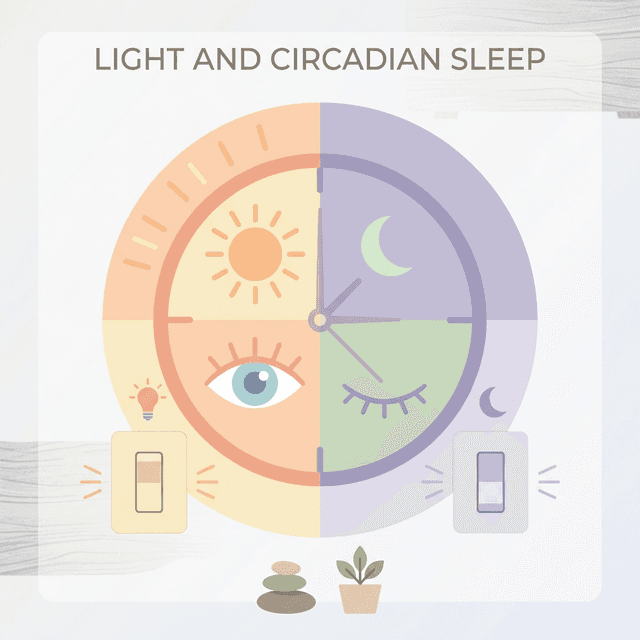
Walker explains this through what he calls the two-process model (Borbély, 1982). The first process is homeostatic: adenosine accumulates during every waking hour, building "sleep pressure" that should peak at bedtime. The second is circadian: your 24-hour internal clock, anchored by light and temperature, dictates when you feel alert and when you feel drowsy. When these two systems are synchronized — when your internal clock and adenosine pressure peak together — sleep comes easily and deeply. Irregular schedules desynchronize them.
Rule 1: Go to bed and wake at the same time every day — weekends included. The variance should be no greater than 15–20 minutes. This is the maintenance shift's start time. Change it constantly, and the crew never gets into rhythm.
The Thermostat Your Body Needs to Find
Your brain cannot enter deep sleep at your daytime core temperature. To fall asleep and stay there, your core temperature must drop by approximately 1°C — and the bedroom environment is the primary mechanism for making that happen (Harding et al., 2019).
Walker consistently recommends a bedroom temperature of 16–18°C (roughly 60–66°F). This is not arbitrary. As the body prepares for sleep, blood vessels in the hands and feet dilate — a process called distal vasodilation — releasing core heat through the skin. The result is a cooling of the body's interior that directly signals sleep onset (Kräuchi et al., 1999). A warm room interferes with this process; the body cannot shed heat efficiently, and sleep is lighter and more fragmented.
Want to try this yourself?
We've built an interactive playground for you to experiment with the concepts from this article.